- Published
- November 2025
- Page Count
- 488
- ISBN (Digital)
- 979-8-88794-557-6
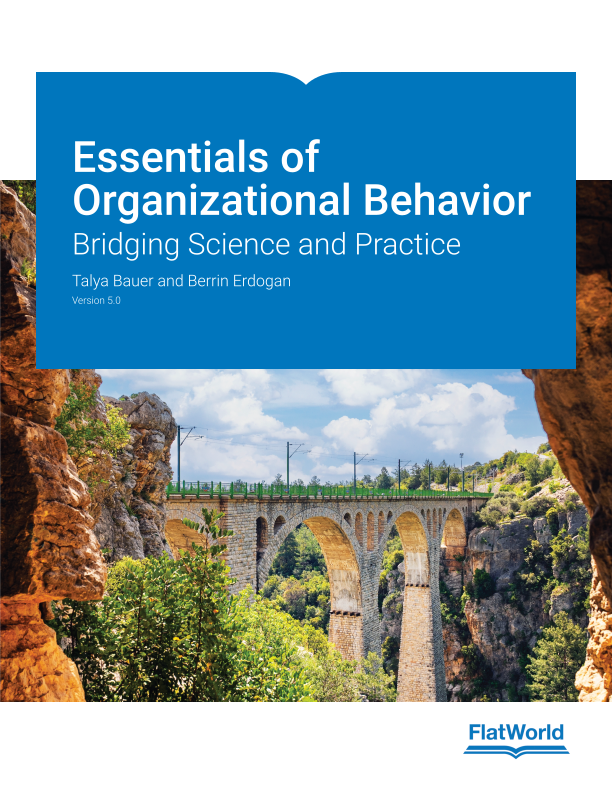
Essentials of Organizational Behavior: Bridging Science and Practice



Version 5.0
By Talya Bauer and Berrin Erdogan
Included Supplements
 Homework
 Manual
 Slides
 Tests
Tests

Key Features
- Provides the most critical, evidence-based organizational behavior (OB) topics in a compact form. The student text numbers 447 pages, which is over 100 pp. shorter than its longer counterpart
- Organized around core values and beliefs about teaching and learning organizational behavior:
- Organizational behavior (OB) matters
- Evidence-based research is the foundation of OB
- Different students learn in different ways
- There is no substitute for hands-on learning
- Learning the language of OB helps you be more effective in the workplace
- Technology can greatly enhance learning
- Flexibility in teaching delivery allows for student success
- Encourages learners to think about the interpersonal implications of their own and others’ actions, understand how to pursue goals more effectively, and become better communicators
- New focus on artificial intelligence, including a new feature called “AI Insights: Navigating the Future of Work” in every chapter
- Over 25 embedded links to streaming videos engage students, stimulate curiosity, and enrich hybrid and online courses
- Strong focus on ethics and using critical thinking to address ethical dilemmas
- Robust theoretical foundation is balanced with applied features such as OB Toolbox
- Integrates global contexts into every chapter
- Case studies with discussion questions are gathered into one, easy-to-find Appendix that enables flexibility to cover or omit cases based on faculty preferences
- Rich and useful learning strategies embedded in the book include:
- Learning Objectives start each main section to preview the chapter and prepare students to learn
- Key Takeaways at the end of every main section to summarize new information while it is still fresh and encourage retention
- New “AI Insights: Navigating the Future of Work” in every chapter
- What Do You Think? scenarios at the end of every main section pose situations for student reflection and thought about reconciling their values with common business situations they may encounter in the future
- Surveys and other self-assessments in every chapter help learners develop a better understanding of themselves as leaders, employees, and colleagues
- OB Toolbox features provide specific suggestions students can immediately use at work as well as saving for future reference
- Ethical Dilemmas as well as Individual Exercises and Group Exercises at the end of every chapter provide rich and interactive learning opportunities
- Customizable
Students
- Online Access Price
- $37.95
- Color Printed Textbook with Online Access Price
- $64.95
Essentials of Organizational Behavior: Bridging Science and Practice is suitable for undergraduate and MBA-level courses on organizational behavior taught in either two- or four-year colleges and universities.
Essentials shares the same themes and approaches that have propelled its full-length counterpart Organizational Behavior: Bridging Science and Practice to become a market-leading textbook. This briefer, essentials version covers core organizational behavior topics and gathers together all opening chapter cases from the full-length book into a single appendix. Essentials will appeal to faculty who prefer a concise treatment of organizational behavior combined with the distinct, experiential approach for which Bauer and Erdogan are well known. Essentials provides the most timely and relevant vocabulary, framework, and critical thinking skills necessary to diagnose situations, ask tough questions, evaluate answers received, and act in an effective and ethical manner across situations.
New in This Version
Overall
- New section in every chapter called “AI Insights: Navigating the Future of Work”
- All cases in Appendix A are new to this version
- Self-assessments now appear in every chapter
- Research throughout is thoroughly updated with post-2000 research, unless it is a classic study
By Chapter
Chapter 1: “Organizational Behavior and You”
- Recast section on trends influencing OB to include AI, automation, technological advances in general, inclusion and diversity, ethics, and corporate social responsibility (Section 1.3)
- New survey examples (pulse and organizational opinion) and the role of time in measurement (cross-sectional and longitudinal data collection) (Section 1.4)
- Significant new subsection on AI technology including keywords on machine learning algorithm, natural language processing, chatbot, and robotics (Section 1.4)
- New ethical dilemma on lack of employee engagement (Section 1.8)
Chapter 2: “Workplace Composition and Inclusion”
- New or expanded topics include
- allyship training, employee resource groups (ERG), hostile work environments, neurodiversity, recruitment advantages, and veterans (Section 2.2)
- recruitment advantages of inclusion, equity, and diversity (IE&D following SHRM) (Section 2.4)
- New OB Toolbox “How to Be an Effective Ally” (Section 2.2)
- New self-assessment “Measuring Your Cultural Orientation” (Section 2.3)
- New ethical dilemma (Section 2.7)
- New individual exercise (Section 2.7)
Chapter 3: “Personality and Values”
- New or expanded topics include
- trait activation theory (Section 3.2)
- dark triad personality traits (Section 3.3)
- imposter thoughts, self-enhancement or self-effacement (Section 3.4)
- New self-assessment “Schwartz Value Survey?” (Section 3.3)
- New individual exercise “Increase your Positivity” (Section 3.8)
Chapter 4: “Attitudes and Behaviors”
- New or expanded topics include
- job embeddedness (Section 4.3)
- moral disengagement (Section 4.4)
- New self-assessment “Job Embeddedness” (Section 4.3)
- New ethical dilemma (Section 4.7)
- New individual exercise “Negative Glassdoor Reviews” (Section 4.7)
- New group exercise “Administering Attitude Surveys” (Section 4.7)
Chapter 5: “Foundations of Motivation”
- Revised chapter title to highlight the chapter’s increased emphasis on foundations of application
- New self-assessment “What Is Your Equity Preference?” (Section 5.4)
Chapter 6: “Designing a Motivating Work Environment”
- Job crafting is now its own subsection with its own OB Toolbox (Section 6.2)
- New or expanded coverage of
- illegitimate tasks and precarious jobs (Section 6.2)
- objectives and key results (OKRs) (Section 6.3)
- restricted stock options (RSUs) (Section 6.5)
- algorithmic management (Section 6.6)
- New self-assessment “Measuring Your Feedback Orientation” (Section 6.4)
Chapter 7: “Stress, Wellness, and Emotions”
- Greater focus on wellness (Sections 7.2 and 7.3)
- New individual exercise “Personal Wellness Assessment and Stress Management Plan” (Section 7.9)
Chapter 8: “Communication”
- New main section on communicating effectively (Section 8.4)
- New or expanded topics include
- chatbots (Section 8.3)
- social media (Section 8.3)
- voice (Section 8.3)
- gossip and rumors (Section 8.4)
- humor (Section 8.5)
- interactional and informational justice (Section 8.5)
- meetings and communicating virtually (Section 8.6)
- New self-assessment “Are You a Good Listener?” (Section 8.4)
- New ethical dilemma “Silencing a Complaining Employee” (Section 8.9)
- New group exercise “Improving Communication Skills” (Section 8.9)
Chapter 9: “Groups and Teams”
- New subsection on teaming and Bernstein's model of teaming; clarifies Tuckman as one possible model but not a prescriptive one (Section 9.2)
- New subsection on technology-enabled and virtual teams (Section 9.3)
- New subsection on innovation (Section 9.3)
- New or expanded topics include
- social effort gains and social loafing (Section 9.2)
- cohesion (Section 9.2)
- New self-assessment “Are You a Good Team Member?” (Section 9.5)
- New group exercise “Teambuilding: The Tower of Success” (Section 9.9)
Chapter 10: “Conflict and Negotiation”
- New subsection on gender and race differences in negotiations (Section 10.5)
- New discussion of mandatory versus voluntary arbitration (Section 10.5)
- New self-assessment “Conflict Resolution Style” (Section 10.4)
- New ethical dilemma (Section 10.9)
- New individual exercise “Reflections on a Conflict” (Section 10.9)
- New group exercise “Let’s Invest in a House” (Section 10.9)
Chapter 11: “Decision Making and Creativity”
- New subsection on technology, fairness, and decision-making (Section 11.2)
- New self-assessment “Decision-Making Confidence Questionnaire” (Section 11.2)
- New individual exercise “Choosing a College Major or Career Change” (Section 11.8)
Chapter 12: “Leading at Work”
- New or expanded coverage of
- exploitative leadership (Section 12.5)
- leader humor (Section 12.5)
- paternalistic leadership (Section 12.6)
- guanxi (Section 12.7)
- New ethical dilemma (Section 12.9)
- New individual exercise “Listen to a Leadership Podcast” (Section 12.9)
Chapter 13: “Power, Influence, and Politics”
- New subsection on preventing harmful organizational politics (Section 13.4)
- New or expanded coverage of
- dependence theory (Section 13.2)
- perceived organizational politics (Section 13.4)
- New self-assessment “Political Skills” (Section 13.4)
- New ethical dilemma “Leadership Scenarios” (Section 13.9)
- New group exercise “LinkedIn Profile” (Section 13.9)
Chapter 14: “Organizational Structure and Change”
- New set of factors under why do people resist change? (Section 14.3)
- New self-assessment "Assessing Your Readiness for Change" (Section 14.3)
- New OB Toolbox “Managed by a Crowd” (Section 14.2)
Chapter 15: “Organizational Culture”
- New self-assessment “New Employee Onboarding Readiness Questionnaire” (Section 15.4)
- New ethical dilemma (Section 15.9)
- New group exercise “I Spy . . . Organizational Culture” (Section 15.9)
- About the Authors
- Acknowledgments
- Preface
-
Chapter 1: Organizational Behavior and You
-
Chapter 2: Workplace Composition and Inclusion
-
Chapter 3: Individual Differences and Perception
-
Chapter 4: Attitudes and Behaviors
-
Chapter 5: Foundation of Motivation
-
Chapter 6: Designing a Motivating Work Environment
-
Chapter 7: Stress, Wellness, and Emotions
-
Chapter 8: Communication
-
Chapter 9: Groups and Teams
-
Chapter 10: Conflict and Negotiation
-
Chapter 11: Decision-Making and Creativity
-
Chapter 12: Leading at Work
-
Chapter 13: Power, Influence, and Politics
-
Chapter 14: Organizational Structure and Change
-
Chapter 15: Organizational Culture
-
Appendix A: Optional Chapter Cases

FlatWorld Homework
FlatWorld Homework includes multi-format questions written specifically for your FlatWorld book, which you can access through our stand-alone interface or integrate with your learning management system.

Instructor’s Manual
The Instructor’s Manual guides you through the main concepts of each chapter and important elements such as learning objectives, key terms, and key takeaways. Can include answers to chapter exercises, group activity suggestions, and discussion questions.

PowerPoint Lecture Notes
A PowerPoint presentation highlighting key learning objectives and the main concepts for each chapter are available for you to use in your classroom. You can either cut and paste sections or use the presentation as a whole.

Test Generator - powered by Cognero
FlatWorld has partnered with Cognero, a leading online assessment system, that allows you to create printable tests from FlatWorld provided content.

Test Bank Files for Import to Learning Management Systems
For your convenience, we've packaged our test items for easy import into Learning Management Systems like Blackboard, Brightspace/D2L, Canvas, Moodle, or Respondus.

Test Item File
Need assistance in supplementing your quizzes and tests? Our test-item files (in Word format) contain many multiple-choice, fill-in-the-blank, and short-answer questions.
At FlatWorld, we take pride in providing a range of high-quality supplements alongside our titles, to help instructors teach effectively. Supplements are available for instructors who have registered their adoption with us. If you need to review or preview something specific, please contact us.
Already registered? Sign in here.