- Published
- September 2026
- Page Count
- 974
- ISBN (Digital)
- 978-1-4533-9484-7
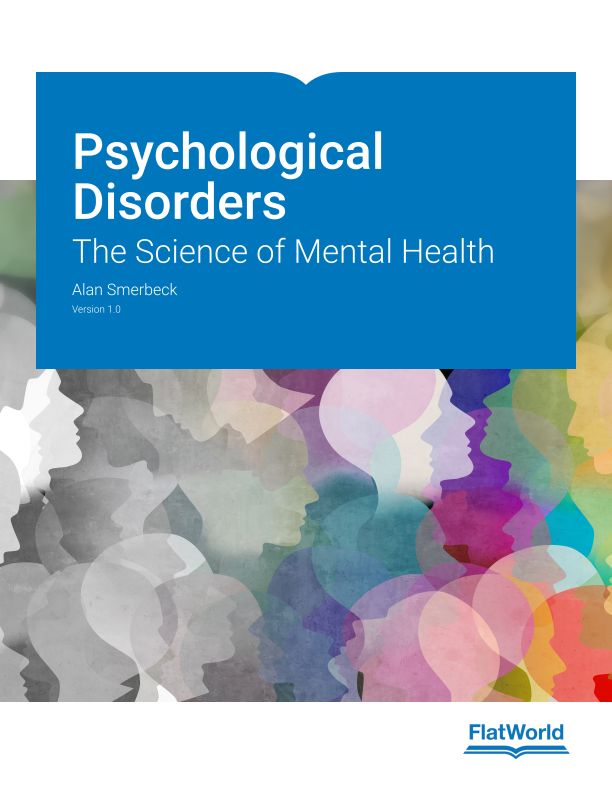
Psychological Disorders: The Science of Mental Health

Version 1.0
By Alan Smerbeck
Included Supplements
 Homework
 Manual
 Slides
 Tests
Tests

Key Features
- DSM-5-TR Alignment: Organizes disorders into conceptual clusters to reveal their underlying connections.
- Integrated Diversity: Explores how human differences shape the experience and diagnosis of mental illness.
- Engaging Narrative: Balances rigorous empirical data with relatable examples and a touch of levity.
- Covers the standard topics in a streamlined and relatable way that emphasizes the development of critical thinking and reasoning skills
- Over 130 embedded links to streaming videos enrich online courses, engage students, and reinforce or augment many of the presented topics
- Consistently addresses human diversity
- Robust descriptions of disorders that do not overwhelm the reader
- Follows the DSM-5-TR classifications (e.g., neurodevelopmental disorders rather than childhood disorders)
- Covers newer influences and treatment modalities such as the effects of COVID-19; mindfulness-based treatments; mental-health apps; novel uses of psychoactive drugs such as ketamine; and increased reliance on telemedicine
- Minimal emphasis on non-evidence-based treatments
- Optimizes student learning
- Highlights and clarifies commonly misunderstood terms such as obsession or antisocial; easily confused terms like psychopathy (lack of empathy and remorse) and psychopathology (all forms of mental illness); and the mistaken assumption that negative reinforcement is synonymous with punishment
- Practical examples from a range of fields beyond psychology, such as education, law, policing, and medicine
- Emphasizes similarities between conditions in each diagnostic category as well as exceptions to make material easier to learn and retain
- Optional cumulative review materials and quiz questions encourage higher orders of synthesis
- Promotes scientific thinking
- Covers fewer studies in greater depth when appropriate by sometimes highlighting one study to discuss at length, informing students of the sample characteristics, the measures, the study design, and the outcome
- Explains how content was discovered and the limitations of research
- Encourages students to distinguish science from pseudoscience by providing explicit instruction in the differences between the conclusions of rigorous research and implausible, untestable, or disproven claims
- Identifies and disputes common myths and misconceptions by revealing how a misconception arose and why it might be harmful.
- Supportive learning features:
- Expert Vocabulary feature recognizes that students are often challenged to adapt their notions about a familiar word in a new context. This feature clarifies potentially confusing terms by distinguishing their definitions in psychology from their common uses; updates outdated terms with current terminology; differentiates multiple uses of the same word; and examines psychological and sociocultural impacts of terms.
- Chapter-Opening vignette showcases a fictional composite of individuals who are dealing with psychological conditions or mental health challenges in contexts familiar to most students. Shorter vignettes are included throughout to ensure each disorder is introduced in an engaging and meaningful way.
- Learning Objectives preview each main head section and help focus the reader’s attention
- Key Terms feature pop-up definitions when read online, or as a marginal glossary when printed
- Key Takeaways at the end of every main head section encourage retention by prompting the reader to chunk new information while it is fresh
- DSM-5 TR Diagnostic Criteria Summaries provide key diagnostic criteria in the chapters centering around disorders (Chapters 5–16)
- Differential Diagnosis demonstrates how the same symptoms can have many different causes and the challenges of determining whether a particular behavior is actually unusual and of clinical severity. Highlights the hazards of armchair and self-diagnosis by emphasizing how students can quickly jump from symptoms to incorrect diagnoses, including the risks and dangers of misdiagnosis. Demonstrates how diagnoses cannot be inferred from a celebrity’s public persona.
- Psychology in the Community feature highlights how text material applies outside of the mental health fields in areas such as law, policing, education, and medicine
- Science and Pseudoscience feature reinforces the text’s key focus on critical thinking, especially when considering the risks of trying new and/or unproven interventions. Each of these features describes an alternative diagnostic or treatment approach, including the evidence for and against its use, and why it might appear to work when it actually does not (such as homeopathy for anxiety disorders in Section 5.3)
- Chapter Summary and Review
- Summary helps students understand the “big picture” significance of the preceding chapter
- Disorder Summaries highlight key elements of disorders discussed in the preceding chapter
- Review Exercises reinforce material just learned and reinforce retention
- Further Learning Resources lists high-interest articles, activities, books, websites, movies, podcasts, and other relevant media curated by the author to provide interactive learning experiences and explore beyond the text
- Instructor’s Manual includes lists of common student misconceptions and misunderstandings and how they might be addressed or corrected
- Fully Customizable
Students
- Online Access Price
- $41.95
- Color Printed Textbook with Online Access Price
- $68.95
Psychological Disorders: The Science of Mental Health is suitable for courses usually called Psychological Disorders, Abnormal Psychology, Introduction to Abnormal Psychology, Psychopathology, or similar titles taught at the undergraduate level at two- and four-year colleges and universities.
Psychological Disorders: The Science of Mental Health explores the origins, traits, and treatments of mental health conditions. Designed for majors and non-majors alike, it champions the scientific method, teaching readers to dismantle pseudoscientific claims and “pop psychology” myths. Compared to other texts, Psychological Disorders: The Science of Mental Health presents fewer studies, but in greater detail, explaining where findings come from. Rather than simply reporting results, the book emphasizes how hypotheses are tested, preparing students to contrast well-supported conclusions with pseudoscientific claims.
This text is sufficiently rigorous for psychology majors and others pursuing mental health-related careers, but is also inviting, accessible, and relevant to non-majors. It was written with the understanding that students arrive in class with a range of backgrounds and makes no presumptions that all readers have the same foundational background knowledge. In addition, it highlights the important ways in which mental health intersects with other fields, including law enforcement, medicine, education, and even sales. The text also teaches and reinforces important principles of scientific thinking which can be applied across disciplines.
In Progress
- All instructor supplements will be available by October 5, 2026.
- Homework system for this title will be live by October 5, 2026.
- Preface
- About the Author
- Acknowledgments
-
Chapter 1: Introduction and Historical Perspectives
-
Chapter 2: Diagnosis and Assessment
-
Chapter 3: Science and Pseudoscience
-
Chapter 4: The Biopsychosocial Model
-
Chapter 5: Anxiety Disorders
-
Chapter 6: Obsessive Compulsive-Related Disorders and Trauma-/Stressor-Related Disorders
-
Chapter 7: Factitious Disorder, Somatic Symptom and Related Disorders, and Dissociative Disorders
-
Chapter 8: Depressive Disorders, Bipolar Disorders, and Suicide
-
Chapter 9: Schizophrenia Spectrum and Other Psychotic Disorders
-
Chapter 10: Neurodevelopmental Disorders
-
Chapter 11: Externalizing Disorders
-
Chapter 12: Substance-Related and Addictive Disorders
-
Chapter 13: Eating, Feeding, and Sleep-Wake Disorders
-
Chapter 14: Personality Disorders
-
Chapter 15: Sexual Dysfunctions and Paraphilias
-
Chapter 16: Neurocognitive Disorders
-
Chapter 17: Careers, Ethics, and Law

FlatWorld Homework
FlatWorld Homework includes multi-format questions written specifically for your FlatWorld book, which you can access through our stand-alone interface or integrate with your learning management system.
Instructor’s Manual
The Instructor’s Manual guides you through the main concepts of each chapter and important elements such as learning objectives, key terms, and key takeaways. Can include answers to chapter exercises, group activity suggestions, and discussion questions.
PowerPoint Lecture Notes
A PowerPoint presentation highlighting key learning objectives and the main concepts for each chapter are available for you to use in your classroom. You can either cut and paste sections or use the presentation as a whole.

Test Generator
Prefer printable tests? Download our test generator and start creating printable tests today! We offer a test generator for both PC and Mac users.

Test Bank Files for Import to Learning Management Systems
For your convenience, we've packaged our test items for easy import into Learning Management Systems like Blackboard, Brightspace/D2L, Canvas, Moodle, or Respondus.
Test Item File
Need assistance in supplementing your quizzes and tests? Our test-item files (in Word format) contain many multiple-choice, fill-in-the-blank, and short-answer questions.
Sample Syllabi
Sample syllabi provide useful templates to help new faculty adopters revise their teaching plans to match their assigned FlatWorld textbook or lend insights to existing adopters on how to organize their classes.
At FlatWorld, we take pride in providing a range of high-quality supplements alongside our titles, to help instructors teach effectively. Supplements are available for instructors who have registered their adoption with us. If you need to review or preview something specific, please contact us.
Already registered? Sign in here.