- Published
- September 2025
- Page Count
- 620
- ISBN (Digital)
- 979-8-88794-403-6
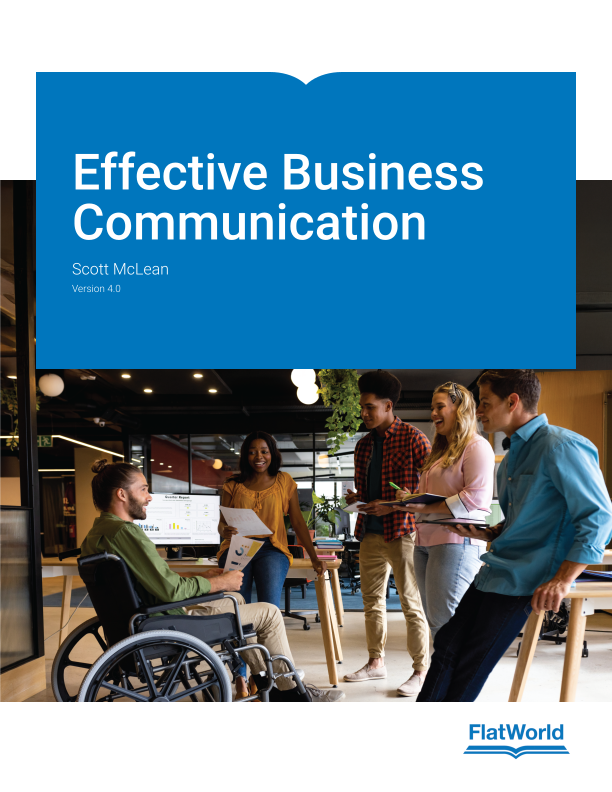
Effective Business Communication



Version 4.0
By Scott McLean
Included Supplements
 Homework
 Manual
 Slides
 Tests
Tests

Key Features
- Strong introduction to soft, transferable skills and conflict management
- Examines communication, culture, and their interactions in practical, real-world contexts
- Includes coverage of public speaking
- Focus on developing critical thinking skills
- Supportive learning features
- Over 140 embedded hyperlinks to streaming videos enrich hybrid and online courses, engage students, and reinforce or augment many of the presented topics
- “Introductory Exercises” set the stage for topics to be presented in the coming chapter
- “Learning Objectives” at the beginning of each main section help guide and focus students’ learning
- Key terms highlight important concepts and terminology throughout the text
- “Key Takeaways” at the end of every main section echo and reinforce the section’s “Learning Objectives”
- “Exercises” at the end of each main section promote deeper learning and retention of new concepts by stimulating critical analysis
- Customizable
Students
- Online Access Price
- $34.95
- Color Printed Textbook with Online Access Price
- $61.95
Effective Business Communication is suitable for courses such as Business Communication, Professional Communication, Communication for Professionals, Managerial Communication, Communication for Business and the Professions, Communicating at Work, or similar course titles taught in business or communication departments at the undergraduate and graduate levels at both two- and four-year institutions.
Effective Business Communication provides a comprehensive, integrated approach to the study and application of written and oral business communication. The book starts with an emphasis on business communication soft skills—increasingly in demand by employers, featured in job descriptions, and clearly related to professional success. Links to self-assessments highlight strengths as well as opportunities for improvement. The book’s second section transitions to a focus on business writing, followed by a third section that features business presentations, conflict, crisis, and intercultural contexts. Each section is supported and enriched by relevant, real world, and current examples.
New in This Version
Overall
- New overarching theme explores mobile communications and their impacts on professional interactions, social media influencers, and personal branding
- Valuable insights into the role of social media influencers and their ability to shape public opinion
- Examines the transformative power of artificial intelligence (AI), encompassing both its current and potential applications
- Thoroughly explores ethical considerations about AI, bias in AI-produced content, and its use in professional communications in business, education, and health-care fields
- Key elements of the previous version’s Chapter 13 moved to Chapter 12
- New Chapter 14 on AI in professional communication
New and updated coverage on
- The SIFT Method and combating misinformation (Section 1.3)
- Social media and digital civility (Section 1.3)
- Preventing a vulnerability hangover (Section 1.8)
- Critical, transferable future job skills (Section 1.11)
- Influencing audiences through social media platforms (Section 2.4)
- The rise of influencers in media (Section 3.5)
- Engaging audiences with clear social media and mobile audience writing principles (Section 3.5)
- Designing interactive documents for mobile audiences (Section 4.5)
- Optimizing online résumés for AI and human eyes (Section 5.6)
- Strategies to effectively enhance online profiles (Section 5.6)
- Strategies to address speech anxiety (Section 6.3)
- Effective visual aids for mobile audiences (Section 7.5)
- Clear and predictable mobile messaging organization (Section 8.4)
- Engaging mobile audiences with informative speaking (Section 9.4)
- The PEOPLE approach to ethical persuasion (Section 10.3)
- Service design presentations (Section 11.11)
- Bullying in the workplace (Section 12.3)
- Emotional labor and emotional work (Section 12.3)
- “Coffee Badging” as a trend (Section 12.4)
- SMART goals (Section 12.5)
- Team communication and conversation (Section 12.8)
- Workplace bullying and hostile work environments (Section 12.8)
- Task sequencing and employee retention (Section 13.5)
- Self-segmentation, echo chambers, and social media groupthink (Section 13.8)
- Introduction to artificial intelligence (AI) (Section 14.2)
- Using AI ethically (Section 14.3)
- Citing and referencing AI (Section 14.3)
- AI and business (Section 14.4)
- AI’s distinct roles including
- From editor to translator (Section 14.4)
- Job interviewing (Section 14.4)
- Stock picking (Section 14.4)
- Education (Section 14.5)
- Health care, such as digital twinning, virtual hearts, and 3D brain models (Section 14.6)
- Relationship advice (Section 14.7)
- AI and the future (Section 14.7)
- AI’s significant energy and environmental costs (Section 14.7)
- About the Author
- Acknowledgments
- Dedication
- Preface
-
Chapter 1: Introduction to Business Communication
-
Chapter 2: Perception, Audience, and Message
-
Chapter 3: The Business Writing Process
-
Chapter 4: Revision, Proofreading, Format, and Design
-
Chapter 5: Business Writing in Action
-
Chapter 6: Business Presentations, Topics, and Stage Fright
-
Chapter 7: Nonverbal Communication, Movement, and Visual Aids in Business Presentations
-
Chapter 8: Presentation Organization and Outlines
-
Chapter 9: Presentations to Inform
-
Chapter 10: Presentations to Persuade
-
Chapter 11: Business Presentations in Action
-
Chapter 12: Business Communication and Conflict
-
Chapter 13: Intercultural and International Business Communication
-
Chapter 14: Artificial Intelligence (AI) and Professional Communication

FlatWorld Homework
FlatWorld Homework includes multi-format questions written specifically for your FlatWorld book, which you can access through our stand-alone interface or integrate with your learning management system.

Instructor’s Manual
The Instructor’s Manual guides you through the main concepts of each chapter and important elements such as learning objectives, key terms, and key takeaways. Can include answers to chapter exercises, group activity suggestions, and discussion questions.

PowerPoint Lecture Notes
A PowerPoint presentation highlighting key learning objectives and the main concepts for each chapter are available for you to use in your classroom. You can either cut and paste sections or use the presentation as a whole.

Test Generator - powered by Cognero
FlatWorld has partnered with Cognero, a leading online assessment system, that allows you to create printable tests from FlatWorld provided content.

Test Bank Files for Import to Learning Management Systems
For your convenience, we've packaged our test items for easy import into Learning Management Systems like Blackboard, Brightspace/D2L, Canvas, Moodle, or Respondus.

Test Item File
Need assistance in supplementing your quizzes and tests? Our test-item files (in Word format) contain many multiple-choice, fill-in-the-blank, and short-answer questions.
Sample Syllabi
Sample syllabi provide useful templates to help new faculty adopters revise their teaching plans to match their assigned FlatWorld textbook or lend insights to existing adopters on how to organize their classes.
DownloadAt FlatWorld, we take pride in providing a range of high-quality supplements alongside our titles, to help instructors teach effectively. Supplements are available for instructors who have registered their adoption with us. If you need to review or preview something specific, please contact us.
Already registered? Sign in here.