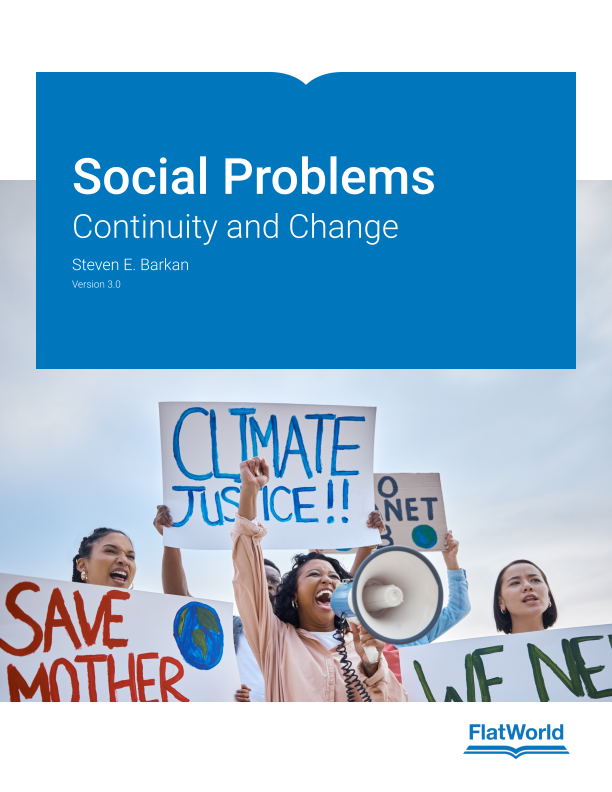
- Published
- January 2026
- Page Count
- 548
- ISBN (Digital)
- 979-8-88794-491-3
Social Problems: Continuity and Change



Version 3.0
By Steven E. Barkan
Included Supplements
 Homework
 Manual
 Slides
 Tests
Tests

Key Features
- Acknowledges the persistence of social problems, but also points out possibilities for beneficial social change
- Each social problem is examined through the lens of three theoretical perspectives: functionalism, conflict theory, and symbolic interactionism
- Over 80 embedded hyperlinks to streaming videos enrich online and hybrid courses, engage students, and reinforce or augment many of the presented topics
- Consistently addresses poverty, racial inequality, and gender inequality in separate chapters and throughout the text
- Supportive learning structure:
- Social Problems in the News stories begin each chapter to engage students’ attention and help them begin thinking about the chapter’s key topics
- Learning Objectives begin each main section and set the stage for the topics to come
- In-Text Features
- Applying Social Research features discusses how findings from sociological and other social science research may contribute to public policy decisions
- Lessons from Other Societies features explain how other nations have successfully addressed social problems
- People Making a Difference features highlight the actions of individuals in effecting social change
- Children and Our Future features examine how social problems affect children now in their later lives
- NEW AI and Social Problems features examine how artificial intelligence might improve or worsen social problems
- For Your Review boxes pose questions to prompt learners to think about key issues
- Key Takeaways end each main section and mirror the preceding “Learning Objectives” to highlight key concepts just learned and promote retention
- End-of-Chapter Material
- Summary boxes highlight major points covered in the preceding chapter
- Using What You Know boxes at the end of every chapter encourage students to apply what they have learned to a potential real-life situation
- What You Can Do boxes suggests several activities, strategies, or other efforts students may undertake to address social problems
- Customizable
Students
- Online Access Price
- $37.95
- Color Printed Textbook with Online Access Price
- $64.95
Social Problems: Continuity and Change v3.0 is intended for courses called Social Problems, Issues in American Society, Problems in Society, or similar titles taught at the undergraduate level in sociology departments at both two- or four-year colleges and universities.
Social Problems: Continuity and Change explores the nature and extent of social problems in America while offering the possibilities for change. It emphasizes the structural bases for social problems, while discussing the real options for positively addressing these challenges. The book highlights applying social research and following examples of people and/or organizations who are bringing about change to effect positive results.
New in This Version
Overall
- Dozens of new and updated references, updated data, and new examples
- New story for each chapter-opening “Social Problems in the News” feature
- New “AI and Social Problems” feature in almost every chapter
- New Chapter 17 “Epilogue: Continuity and Change in Social Problems” reviews what students will have learned from the book and comments on developments during the first 100 days of Donald Trump’s second presidency that had particular relevance for social problems
By Chapter
- Chapter 1 “Understanding Social Problems”
- California legislation banning four food additives to illustrate social change stemming from policymakers’ actions
- Chapter 2 “Poverty and Economic Inequality”
- New chapter title
- New section on economic inequality
- New coverage of middle-class economic problems
- Updated U.S. poverty data
- Revised discussion of the work status of people in poverty
- Updated data on deaths caused by poverty
- Updated peer nation poverty data
- Updated global poverty data
- Chapter 3 “Racial and Ethnic Inequality”
- Updated survey data on racial prejudice
- New discussions of structural racism and of microaggressions
- New section on institutional discrimination in criminal justice
- New data on selected indicators of racial and ethnic inequality
- Revised discussion of affirmative action to reflect the 2023 Supreme Court case banning the explicit use of race in college admissions
- Chapter 4 “Gender Inequality”
- Expanded discussion of mass media and gender socialization
- Updated data on global problems that women experience
- New survey data on prevalence of sexual harassment
- Updated data on rape and sexual assault
- New section on Abortion Rights and Reproductive Freedom (moved from previous version’s Chapter 9)
- Chapter 5 “Sexual Orientation, Gender Identity, and Inequality”
- Updated data on numbers of LGBTQ+ people
- Updated public opinion data on heterosexism
- New discussion of possible threats to legality of same-sex marriage and same-sex relations
- Updated data on hate crimes against LGBTQ+ people
- Updated data on bullying of LGBTQ+ youths
- Updated data on homelessness among LGBTQ youths
- Updated survey data on workplace mistreatment experienced by LGBT employees
- Updated HIV data
- Updated survey data on LGBTQ+ mental health and health care problems
- New discussion of LGBTQ+ people’s criminal justice experiences and perceptions
- New section on transgender youths and gender-affirming care
- New discussion of trans adults
- Chapter 6 “Aging and Ageism”
- Updated life expectancy and population 65 and older data
- Updated health data
- Updated age discrimination in workplace data
- Chapter 7 “Alcohol and Other Drugs”
- New prescription drug use data
- New data on deaths from alcohol, tobacco, and illegal and prescription drugs
- Updated data on alcohol and tobacco use and alcohol consumption
- Expanded discussion of college-student drinking
- Updated discussion of Portugal’s decriminalization experience
- Chapter 8 “Crime and Criminal Justice”
- Updated crime and victimization data
- New section on gun violence and gun safety
- Updated incarceration data
- Chapter 9 “Sexual Behavior”
- Updated data on views about sexual issues
- Updated sexual behavior, pregnancy, and birth data
- Updated abortion data
- New discussion of sex trafficking
- Chapter 10 “The Changing Family”
- Updated data on children’s living arrangements
- Updated data on cohabitation
- Updated family violence data
- Chapter 11 “Schools and Education”
- Updated school enrollment data
- Updated educational attainment data
- Updated school shooting and violence data
- Updated college expense data
- Updated data on mental health issues of college students
- New discussion of 2023 Supreme Court decision banning race-conscious college admissions
- Updated college graduation rate data
- Chapter 12 “Economy and Politics”
- New chapter title
- New discussions of political systems, pluralist and elite theories, corporate lobbying and influence, and voting rights restrictions and other threats to democracy
- Updated labor force and unemployment data
- New People Making a Difference feature
- Updated tax evasion data
- Chapter 13 “Health and Health Care”
- Updated global child mortality and life expectancy data
- Updated life expectancy and infant mortality data
- Updated insurance coverage data
- Updated health expenditure data
- Chapter 14 “Urban and Rural Problems”
- Updated urbanization data
- Updated traffic congestion data
- Chapter 15 “Population and the Environment”
- Updated population data
- Updated immigration data
- New data on mass deportation costs
- Updated environmental problems data
- Chapter 16 “War and Terrorism”
- Updated nuclear warhead data
- Updated military sexual assault data
- Updated military budget data
- New Chapter 17 “Epilogue: Continuity and Change in Social Problems” reviews what students will have learned from the book and comments on developments during the first 100 days of Donald Trump’s second presidency that had particular relevance for social problems
- About the Author
- Acknowledgments
- Preface
-
Part 1: Social Problems in Sociological Perspective
-
Chapter 1: Understanding Social Problems
-
Part 2: Problems of Social Inequality
-
Chapter 2: Poverty and Economic Inequality
-
Chapter 3: Racial and Ethnic Inequality
-
Chapter 4: Gender Inequality
-
Chapter 5: Sexual Orientation, Gender Identity, and Inequality
-
Chapter 6: Aging and Ageism
-
Part 3: Problems of Well-Being and Behavior
-
Chapter 7: Alcohol and Other Drugs
-
Chapter 8: Crime and Criminal Justice
-
Chapter 9: Sexual Behavior
-
Part 4: Problems of Social Institutions
-
Chapter 10: The Changing Family
-
Chapter 11: Schools and Education
-
Chapter 12: Economy and Politics
-
Chapter 13: Health and Health Care
-
Part 5: Global Problems
-
Chapter 14: Urban and Rural Problems
-
Chapter 15: Population and the Environment
-
Chapter 16: War and Terrorism
-
Chapter 17: Epilogue: Continuity and Change in Social Problems

FlatWorld Homework
FlatWorld Homework includes multi-format questions written specifically for your FlatWorld book, which you can access through our stand-alone interface or integrate with your learning management system.

Instructor’s Manual
The Instructor’s Manual guides you through the main concepts of each chapter and important elements such as learning objectives, key terms, and key takeaways. Can include answers to chapter exercises, group activity suggestions, and discussion questions.

PowerPoint Lecture Notes
A PowerPoint presentation highlighting key learning objectives and the main concepts for each chapter are available for you to use in your classroom. You can either cut and paste sections or use the presentation as a whole.

Test Generator - powered by Cognero
FlatWorld has partnered with Cognero, a leading online assessment system, that allows you to create printable tests from FlatWorld provided content.

Test Bank Files for Import to Learning Management Systems
For your convenience, we've packaged our test items for easy import into Learning Management Systems like Blackboard, Brightspace/D2L, Canvas, Moodle, or Respondus.

Test Item File
Need assistance in supplementing your quizzes and tests? Our test-item files (in Word format) contain many multiple-choice, fill-in-the-blank, and short-answer questions.
Sample Syllabi
Sample syllabi provide useful templates to help new faculty adopters revise their teaching plans to match their assigned FlatWorld textbook or lend insights to existing adopters on how to organize their classes.
DownloadAt FlatWorld, we take pride in providing a range of high-quality supplements alongside our titles, to help instructors teach effectively. Supplements are available for instructors who have registered their adoption with us. If you need to review or preview something specific, please contact us.
Already registered? Sign in here.